Search
When research data are publicly accessible, they are usually housed in a so-called repository, i.e. a server or managed directory set up for data storage. Data centers maintain repositories, sometimes several, organized by subject. Some research groups or institutes also have their own repositories.
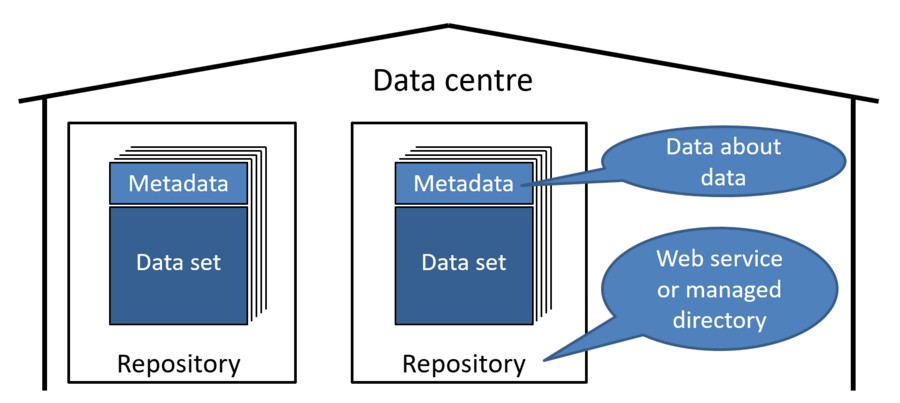
The research data stored there are accompanied by metadata. Metadata is data about data, e.g. the title and author of the dataset. It is possible to search through some of this metadata, often conveniently via the web.
We would like to suggest three search strategies for finding research data:
- Research publications in scientific journals often include information on how to access the underlying research data, such as web links. An increasing number of scientific journals require authors to provide such links. These links should lead you to the research data that form the basis of the publication.
- Two-step web search: first search for repositories, then search for specific datasets within the repository's web portal. The most important portal for finding repositories or data centers is re3data (registry of research data repositories)
- Direct web search for datasets. There are also web-based search tools for this purpose:
- Google Dataset Search
- other search engines
- EUDAT B2FIND
- DataCite Search (covers not only research data but also items such as articles and presentation slides)
Datasets can only be found via search engines if the metadata schema used by the repository is interpretable by the search engine (i.e., is "interoperable"). Repositories must be registered by their operators e.g. in re3data or EUDAT B2FIND in order to be discoverable there. Only web objects assigned a DataCite DOI can be found via the DataCite search. Consequently, when using these portals, there is never any guarantee that all existing research data can actually be found.
To obtain further information about any existing research data, it is also recommended to attend specialist conferences and seek out conversations with experts in the respective field of research. Furthermore, a large proportion of existing research data cannot be published, e.g. because it contains personal data.